Does Scent Marketing Actually Work? The Evidence
Yes — but modestly and conditionally. More than 30 years of peer-reviewed research, including two large meta-analyses, show that a pleasant ambient scent reliably improves shoppers' mood, how they judge a store and its products, how long they stay, and how much they spend. The average effect is small to moderate, and it is strongest when the scent is pleasant, familiar, and congruent with what is being sold.

The short answer
Scent marketing works — the effect is real, repeatedly measured, and positive — but it is a moderate lever, not magic. The right scent makes a space more pleasant, keeps people in it a little longer, and nudges spending up. The wrong scent, or one that doesn't fit the brand, does little or can even hurt. So the honest answer for an owner is: yes, it works, and it's worth doing, as long as you match the scent well and measure the result rather than trusting a headline statistic.
What the research actually shows
Three pieces of evidence matter most, because they pool many studies rather than relying on one:
- The foundational experiment. Spangenberg, Crowley and Henderson (1996, Journal of Marketing) compared a scented and an unscented version of the same store and found shoppers rated the scented store more positively and behaved more favourably in it.
- The Journal of Retailing meta-analysis. Roschk, Loureiro and Breitsohl (2017) pooled about 66 studies on music, scent and colour. Environments with a pleasant scent produced higher pleasure, satisfaction and behavioural-intention ratings than unscented ones — with effects ranging from small to medium, and a tendency to be stronger in service settings (like cafés) than in plain retail.
- The 2020 meta-analysis. Roschk and Hosseinpour (2020, Journal of Marketing) integrated 671 individual effects from 64 studies. They found pleasant ambient scent reliably increases customer responses — emotions, evaluations, behaviour and spending — and that the gains are largest when the scent is pleasant, familiar, and congruent with the products on sale.
The pattern across all three is consistent: a real, positive, repeatable effect, with congruence as the deciding factor.
| Source | What it pooled | What it found |
|---|---|---|
| Spangenberg, Crowley & Henderson (1996), Journal of Marketing | Controlled scented vs unscented store experiment | Scented store earned better evaluations and behaviour |
| Roschk, Loureiro & Breitsohl (2017), Journal of Retailing | ~66 studies (music, scent, colour) | Pleasant scent raises pleasure, satisfaction and intent; small-to-medium effect, stronger in service settings |
| Roschk & Hosseinpour (2020), Journal of Marketing | 671 effects across 64 studies | Reliable lift in responses and spending; biggest when scent is pleasant, familiar and congruent |
How big is the effect, really?
This is where honesty matters. The 2020 meta-analysis put the average lift in customer responses in the region of a few to around fifteen percent, with spending up a few percent on average. Individual studies of a well-matched scent report bigger numbers, and you'll often see eye-catching figures online — a coffee aroma lifting purchase intent, or a single petrol-station test multiplying coffee sales. Those are best-case single results, not averages, so they're useful as proof the mechanism can be powerful, but a poor basis for what your shop should expect.
The sensible planning assumption: a pleasant, well-matched scent gives a reliable single-digit to low-double-digit lift in the right conditions — small enough that you should measure it, large enough that a fixed monthly programme quoted to your space pays for itself easily.
Why scent works at all
Smell is the only sense wired almost directly into the brain's limbic system — the seat of emotion and memory — rather than being routed first through the rational, evaluative parts of the brain. That's why a scent can trigger a mood or a memory before you've consciously noticed it, and why a pleasant ambient scent quietly makes a space feel more welcoming. It's also why scent is unusually good at building brand recall: the smell becomes attached to the memory of the place.
When scent marketing fails
The research is just as clear about what doesn't work, which is the part hype tends to skip:
- Incongruent scent. A smell that doesn't fit the product or brand adds little. Congruence is the single biggest moderator in the meta-analyses.
- Unpleasant or overpowering scent. Too strong, too cheap, or simply disliked, and the effect reverses — it drives people away.
- Complex, muddy blends. Simple, clear "aroma structures" tend to outperform complicated ones.
In short, the lever works, but only when pulled carefully — which is exactly why matching and tuning the scent is the job, not just switching on a diffuser.
Does it work for cold F&B?
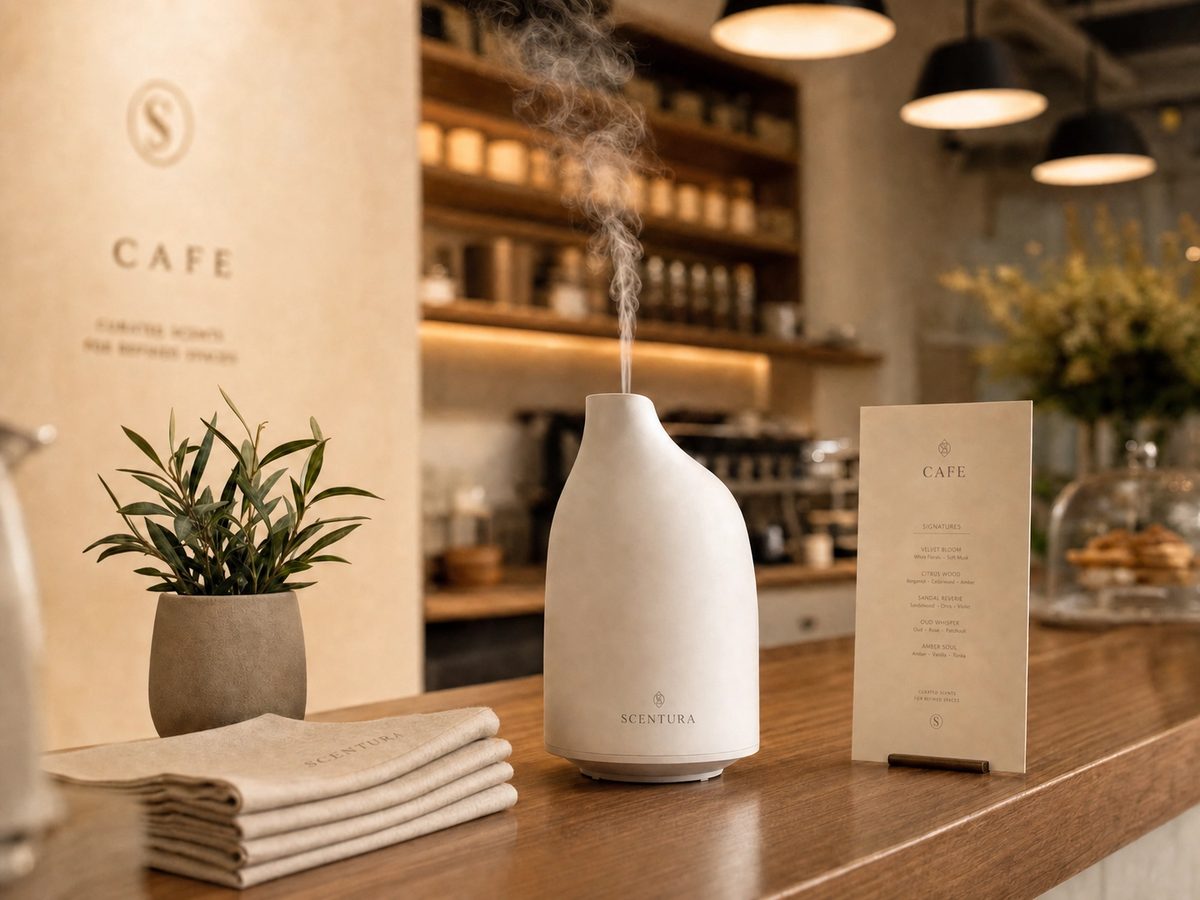
It's arguably where scent has the most to add. The research is about ambient scent diffused into a space — not the smell of the product itself. Hot food already perfumes the air, so a bakery or coffee roaster gets that pull for free. Cold drinks and desserts give off almost no aroma, so a bubble tea shop or gelato café has no natural scent cue at all. A diffused, congruent signature scent supplies the missing ingredient — which is why this is the gap Scentura focuses on. See our guides on scent marketing for bubble tea shops and scent marketing for cafés.
How to prove it for your own shop
Because the effect is real but moderate and context-dependent, the only number that should decide it is yours. That's how Scentura runs it: a paid two-week live pilot that compares your takings on scented days against your normal days, with a scent matched to your hero product. It's one upfront pilot fee — from S$50 for independent cafés and F&B or retail kiosks, up to S$150 for larger or multi-level commercial spaces — credited to your first month if you continue, and refunded in full if it isn't right. You don't take the research on faith — you watch it work, or not, on your own till.
Common questions
Does scent marketing actually work?
Yes, but modestly and conditionally. Decades of peer-reviewed research, including two large meta-analyses, show a pleasant ambient scent reliably improves shoppers' mood, their evaluation of a store and its products, how long they stay, and how much they spend. The average effect is small to moderate, and strongest when the scent is pleasant, familiar and congruent with what's being sold.
How much does scent marketing increase sales?
On average, a modest amount — a 2020 meta-analysis of 671 effects found pleasant ambient scent lifts customer responses by roughly 3 to 15 percent, with spending up about 3 percent on average. Well-matched scents in individual studies report larger gains. The bigger headline figures are best-case single studies, not averages, so the realistic expectation is a reliable but moderate lift you should measure in your own shop.
Is the evidence for scent marketing reliable?
It's reasonably strong. The effect has been tested for over 30 years and confirmed by two independent meta-analyses — Roschk, Loureiro & Breitsohl (2017) in the Journal of Retailing and Roschk & Hosseinpour (2020) in the Journal of Marketing — each pooling dozens of studies. They agree the effect is real and positive, while cautioning that it's moderate and depends on the scent being pleasant and congruent.
Does scent marketing work if my product has no smell, like cold drinks?
Yes. The research is about ambient scent diffused into the space, not the smell of the product itself. Cold drinks and desserts give off almost no aroma, so a diffused signature scent supplies a cue the shop would otherwise lack — which is exactly where it has the most to add.
See it work on your own numbers.
A paid two-week live pilot, fully managed, no lock-in — the fee is credited to your first month, or refunded in full if it isn't right.
Book a two-week pilot →- Spangenberg, E. R., Crowley, A. E., & Henderson, P. W. (1996). Improving the Store Environment: Do Olfactory Cues Affect Evaluations and Behaviors? Journal of Marketing, 60(2). Link
- Roschk, H., Loureiro, S. M. C., & Breitsohl, J. (2017). Calibrating 30 Years of Experimental Research: A Meta-Analysis of the Atmospheric Effects of Music, Scent, and Color. Journal of Retailing, 93(2). Link
- Roschk, H., & Hosseinpour, M. (2020). Pleasant Ambient Scents: A Meta-Analysis of Customer Responses and Situational Contingencies. Journal of Marketing, 84(1). Link